‘Community’ Review: Your Bible Study Ain’t Right Yet

Community groups (small groups) are not easy to execute successfully. Most churches tackle them incorrectly, like they are just another program or a once-a-week Bible study without much depth. Brad House has written Community, an amazing book outlining how not to do small groups and much more on how to do them in a way that keeps Christ the center of everything. Best of all, the book is barely 200 pages long, meaning you can easily finish it in a week or so and still take away great and godly wisdom on how community groups function in light of the Gospel.

How do you stay in the Gospel when practically talking about groups of people? Moreover, how do you even define a broad term like “community?” Luckily, House simplifies this by anchoring the definition of community primarily in 1 Peter 2:9-10. He revisits that passage as he underscores different issues within a community all throughout the book.

The author points readers into a new direction for small groups unlike most people have experienced before, a direction that requires organization, discipline, and authentic repentance. He spends good length outlining what both leaders and simple laymen need to repent of in a community; how else will people grow if they don’t repent of the sin directly in the way first? I feel that many Christian, practical books call for new methods in various fields but fail to talk about repenting of specific and relevant sins there.

In dealing with depending on the Lord to defeat sin that clouds true community, House also beats the drum on mission and how integral it is for Christians in small groups to passionately grasp it in their lives and neighborhoods. This is one of the heartbeats of the Gospel that can’t be missed (of course none can be missed). He also comprehensively covers what sorts of events and projects community groups can undertake in their neighborhoods, what a true small group leader looks like, and how churches should rally their groups together in an organized way without making them just another church event. Instead, the venue Christians should use to live out the Gospel each week should be their small groups.

The honesty in this book is powerful. House calls on leaders to take time to research the needs of the areas where small groups meet and readily admits that differing groups will reach out to places differently based on demographic factors. Also, he’s not afraid to name the sins that disqualify leaders and community groups from being effective for Christ. He provides statistics to reveal just how much the church has failed with community in recent years, and he displays many graphs and charts to visually lay out what he is saying. While the material is not complex at all, lazy leaders and readers should probably stay away from this one.

Another evident feature of the book is resources. At many points while reading leaders will wonder how in the world they will be able to integrate everything House is saying into their own communities, but he literally acknowledges that hurdle and generously gives a plethora of tips and valuable methods along the way (not to mention there is plenty of extra content at the back of the book to assist leaders further). Towards the end of the book he tells the story of community at Mars Hill and takes the time to talk about the lessons they’ve used for leaders and community groups over the years. It is humbling to see just how much House has poured what the Mars Hill team has learned and tried with community into this book. In short, there is plenty of inspiration here to help any leader brainstorm and seek the Holy Spirit in nurturing true community where they’re at.

The one thing I will say is that Community is pointed at a specific audience. I believe the best audience for this one is higher-up pastors, elders, and small group leaders (I say this being a community group leader of three years and a first-year CG coach). But even if the standard layperson purchases this, the impressive blending of practicality, theology, and motivation will not be easily missed. To be honest, this is one of my favorite books I was able to read in 2011. Thank you so much for this, Brad House. I have walked away from this book with so much insight that I’ve already been able to pass down to my leaders. It’s already making an impact.

Community: Taking Your Small Group off Life Support


Lifting the Weights

People treat their relationship with God like it’s a movie, something they pay a little bit of money for to entertain them for a little bit of time. No wonder many of us feel like we’re watching boring re-runs. No wonder many of us become lazy sitting on our couches watching, or entitled, since movies are made for our glorious entertainment. No wonder many of us are left doubting so much and not knowing what to do, like you just paid $10 to see a terrible movie with no one to even talk about it with after.

We need to open our eyes. God is not here to entertain us. It’s not a give-and-take thing; that’s religion. Instead, you were bought with a price. Glorify God with your body (1 Corinthians 6:20). Worship him by being a living sacrifice (Romans 12:1).

I wish Christians would compare their relationship with God more like going to the gym. It’s not easy. Sure, it’s refreshing and good for you, but it takes a lot of work. There’s no point in going once a month or even once a week to be honest. To get any sort of growth you have to keep at it consistently, and you’ll have to accept doing exercises you may not enjoy. At first. And if you go to the gym for the wrong reasons, it shows. That’s a lot like how an authentic relationship with God is.

It sounds like too much work to be of any worth, until you have been going to the gym consistently for years. Is it any less work? No. However, you’ll have grown in mind and body so much the fruit and benefit of the work will happily keep you motivated. All the heavy lifting has paid off and always will, so long as you keep investing.

The amusing thing is that God is far more than weights or any cardio routine. We marvel at what a gym can do to a man or woman who takes the time to invest, but how much more will God do to the servant that faithfully invests in him? Instead of doing power cleans twice a week for two years, go and invite your unbelieving friends and neighbors over once a week for two years. Get up early to pray five days a week for twenty years. Mentor someone once a week for five years. How much more will God do to your soul, your innermost being, than weights will do to your physical, decaying body? Didn’t Jesus say your soul counts for so much more anyway?

“His divine power has granted to us all things that pertain to life and godliness, through the knowledge of him who called us to his own glory and excellence, by which he has granted to us his precious and very great promises, so that through them you may become partakers of the divine nature, having escaped from the corruption that is in the world because of sinful desire.” 2 Peter 1:3-4.

Some of us need to change the way we see God in our lives. Who serves who? Who puts in the work? Who gives grace, and who gets glory?

Time to go to the gym.

Generous Justice

If there’s one thing we Americans do not do well, it’s handling money. We lose it. We spend it. We don’t like giving it away. Those of us who actually do handle money well tend to have the wrong attitude about it (pride much?), putting us back at square one. We typically forget that our money is not really ours at all. It’s God’s. We also tend to neglect what we are supposed to be doing with God’s money. Not only that, but we are supposed to be dealing with all of our resources, including time and possessions, in the same manner. This is where Generous Justice comes into play. Did you know that how you handle your money and things tells about how you understand the Gospel? Oh, how this book packs a punch. The kind that sends Mike Tyson into Build-A-Bear.

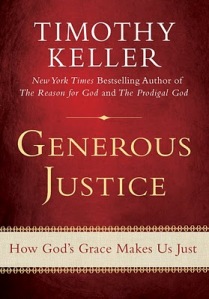
At first glance the cover may come off as being about penal substitution or something, but this book entails something much simpler yet deeper. God’s “justice” is more than just punishing the bad guys. Tim Keller takes a theological dive into Deuteronomy and unveils that true justice (called mishpat in Hebrew) is also about doing the right thing for the people as is due, like serving widows, feeding the poor, and providing for the needy. Keller uses Scripture to show that God expected Israel to leave no one behind in terms of material need, and that same provisional love extends to Christians today.

Using a combination of Scripture and anecdotes, the author paves the way on how to do social justice God’s way, not the political way or any other. The whole premise of the book is founded on Christ’s love for us. Keller asserts that a Christian should be able to look at a homeless person and feel love that causes them to provide for the person’s needs, because on a spiritual level we are all poor like the homeless man. We had no hope, and God showed us His grace, thus providing us with what we need (God’s justice). After experiencing God’s grace as such, we treat people in need with that loving justice as well (hence the subtitle, “How God’s Grace Makes Us Just”). In other words, if you aren’t generous with your time and money, that means you may not really understand the Gospel. Big words.

My favorite parts of this book were the practical ones. Tim Keller talks bluntly about the difference between numbered donations and actually getting your hands dirty in your community. In the last third of the book the author wades through many practical issues: what generosity looks like as a Christian individual, how the church works out this concept of being generous, and how the church can play a role in fighting corrupt local policies.

All in all, Generous Justice tackles a subject many Christians shy away from in an easy-to-read manner. This book really resonated with me as I feel that being generous (namely with money) has always been a bit of a struggle for me. I definitely recommend this to everyone, but if you have a hard time giving at any level you especially need to get your hands on this thing. You’ll how the heart of God goes out to those who society has long left behind.

Generous Justice: How God’s Grace Makes Us Just

Keeping Your Best (Homeward Bound, Pt. 2)

There is something you are best at in your life. Paul tells us in 1 Corinthians 12 and Romans 12:6-8 all about the different spiritual gifts God gives His people. So whether it’s teaching, art, cooking, service, or whatever, there is something you are best at that correlates with your spiritual gift(s). Do you know what that is for you?

A while back I talked about cutting out the things that waste your time the most, but today’s post highlights the other big lesson I learned over in Santa Barbara — finding healthy, productive activities in your free time. Finding things that keep you doing your best.

At first glance, crushing time-wasters and finding productive stuff to do sound almost the same. However, they’ve very different. For instance, let’s say I’m very good at drawing and feel a calling to graphic design, but I have a problem with watching too much TV. So, let’s say I eventually decide to stop watching TV to focus more on drawing, but instead of sketching more, to hone in on my gift, I instead pick up the hobby of yo-yoing. It’s not exactly a waste of time, and I could even argue it keeps the creative juices flowing. But is it really the most productive thing I could be doing for my calling to graphic design? No.

What gives? It seems like once we find out what God’s best equipped us with, we put it off because, if we’re best at it, we feel we can do it anytime we want. We treat it like a talent, when we should be treating it like a skill. Skills must be practiced, over and over.

Think of it like a knife; you’ll need to sharpen it over and over until the day you die. Otherwise, your blade will become dull, and you won’t be able to fully live the life God desires for you.

One thing I love about my fiancé is her ability to cook. She is never afraid to experiment and try new things, and I think that’s what keeps her cooking so amazing. While she has some amazing recipes, it’s her cooking that makes them so utterly delectable. Not the recipes themselves. What if she never experimented with new foods? Her ability to cook would probably go down as she gets complacent with the same recipes, time after time. (Disclaimer: I’m just using an example — I’m not trying to say those who cook must scrap all their good recipes over time).

It’s the same reason why NBA players work out during the day instead of going shopping (although watching a few episodes of Cribs would reveal they probably get a lot of time in for that as well).

It’s the same reason why the best singers sing random tunes in a lot of their free time versus playing solitaire on a computer all day.

If you want something to keep in mind, Paul sums it up pretty well:

“Do not be slothful in zeal, be fervent in spirit, serve the Lord.” Romans 12:11.

One key thing to remember is that whatever you are best at came from God. Therefore, that’s exactly where it should be pointing to. But it won’t if your gifts are all about you, or you neglect building them up.

Now that you’ve gotten the time-wasters out of the way, how can you be active in fine-tuning the things God has given you to do best?

Homeward Bound, Part 1

Cool picture by x-inna.

It’s hard to believe over two months has already passed. Summertime is coming to a close, and this is my last weekend out here in Santa Barbara, CA (I fly back Monday). It actually is a bittersweet thing. I’m ready to go home to my friends, family, and the love of my life, but I’ve been able to enjoy a satisfying job and a wonderful new niece that I will miss along with the town of Santa Barbara. The food, the mountains, the ocean — it’s majestic here!

I’m grateful to have largely been out of my comfort zone while here. Being in an unfamiliar town for over two months with barely any friends has been great for my heart. God has shown me some of the deeper idols I didn’t see so well before, and I’ve been able to witness a lot of eye-opening truths about what it means to be a godly husband and father. This has been indispendable as I am getting ready for some of the biggest and best chapters of my life.

God has indeed taught me a lot of things, so I wanted to focus on the big two I learned while out here. As you have probably surmised, today’s post is about the first one.

Let’s talk about risks.They’re exciting with a side of uncertainty, making them scary as well. Some argue that being safe is always a better idea than taking risks; others have opened the door to many new opportunities as a result of a risk being taken.

Should Christians be in the business of taking risks? Yes, but please let me clarify:

It’s not always worth it to take risks, but risks taken are always worth it.

To put it simply, it’s not smart to take every possible financial, spiritual, or relational risk you find, but when you prayerfully consider, weigh, and faithfully take a risk, it will end up being worth taken.

Consider my trip. I think of it as a risk, since coming to California for over two months did come with some personal costs -

I was nervous about spending the summer in California. Being away from my girlfriend for over two months wasn’t going to be easy (even though she did visit for a week). Being away from my family was another strain, and being away from my closest friends definitely proved to be a challenge. Also, staying with my brother and sister out here when they just had their first baby would indeed be a trying transition.  However, looking back on what I’ve learned and experienced here, I’ve had a blast! Not to mention I’ve had the privilege of getting to know some wonderful folks. The risk was worth it.

My job here has been in sales (I find and reach out to prospective clients for my brother to work his sales-magic on), and is thus extremely free in terms of how to get work done. There is plenty of room for creativity to boost production. While this takes off a lot of pressure in terms of day-to-day tasks, one wrong move can completely turn off clients and make the company look very bad. However, not only have I developed attributes in this environment that I think will be beneficial in ministry, but I’ve also been able to come up with a few work methods that will change the way my brother’s team works internally. Once again, the risk was worth it.

Anecdotes aside, there are three, practical reasons why risks taken are worth it:

1. It takes great faith in God to take a risk. Think of Moses, Gideon, and Jonathan. We see their lives of faith, and when we take risks in any capacity for God today, it stands as a testimony to Him for others. Throughout Scripture we see God using people who take risks, and He wants to use us to make an impact when we leap out in faith, too!

2. Like change, God uses periods of risk as periods of growth. Any time you step out of your comfort zone in faith, you better believe God is going to refine you in some way. Whether it is showing you sin that needs repentance or giving you new desires for the future God wants to use you for, growth occurs when you take risks.

3. If taking a risk ends up working out like you thought or completely flopping, you can always walk away wiser! Did an outreach plan succeed? Awesome. Now you can keep expanding in the right direction. Did it fall through on it’s head? That’s good, too, because next time you now have an idea for what doesn’t work in your community. Proverbs 1:5 – “Let the wise hear and increase in learning, and the one who understands obtain guidance…”

There you have it! Because of God’s creativity and power, we as His image-bearers have dreams and aspirations. He put those there, and it glorifies Him when we pursue those desires He’s placed in our souls.

Your mind may be thinking about that one thing you’ve really been wanting to do lately. A new video project? Start a non-profit? Sit still and wait amidst financial pressures? Whatever it is, go for it! Just like God told Gideon in Judges 6, “I will be with you,” so He’s always with you, too.

Lastly, don’t get caught up in the word ‘risk’. They don’t have to be immensely dangerous to qualify or whatever. A risk is merely an opportunity with a noticeable cost. Just be sure that as you take those leaps and risks for God, you do so in prayer and faith, being led by the Spirit.

What risks do you really want to take? Are there any big opportunities laying before you?